
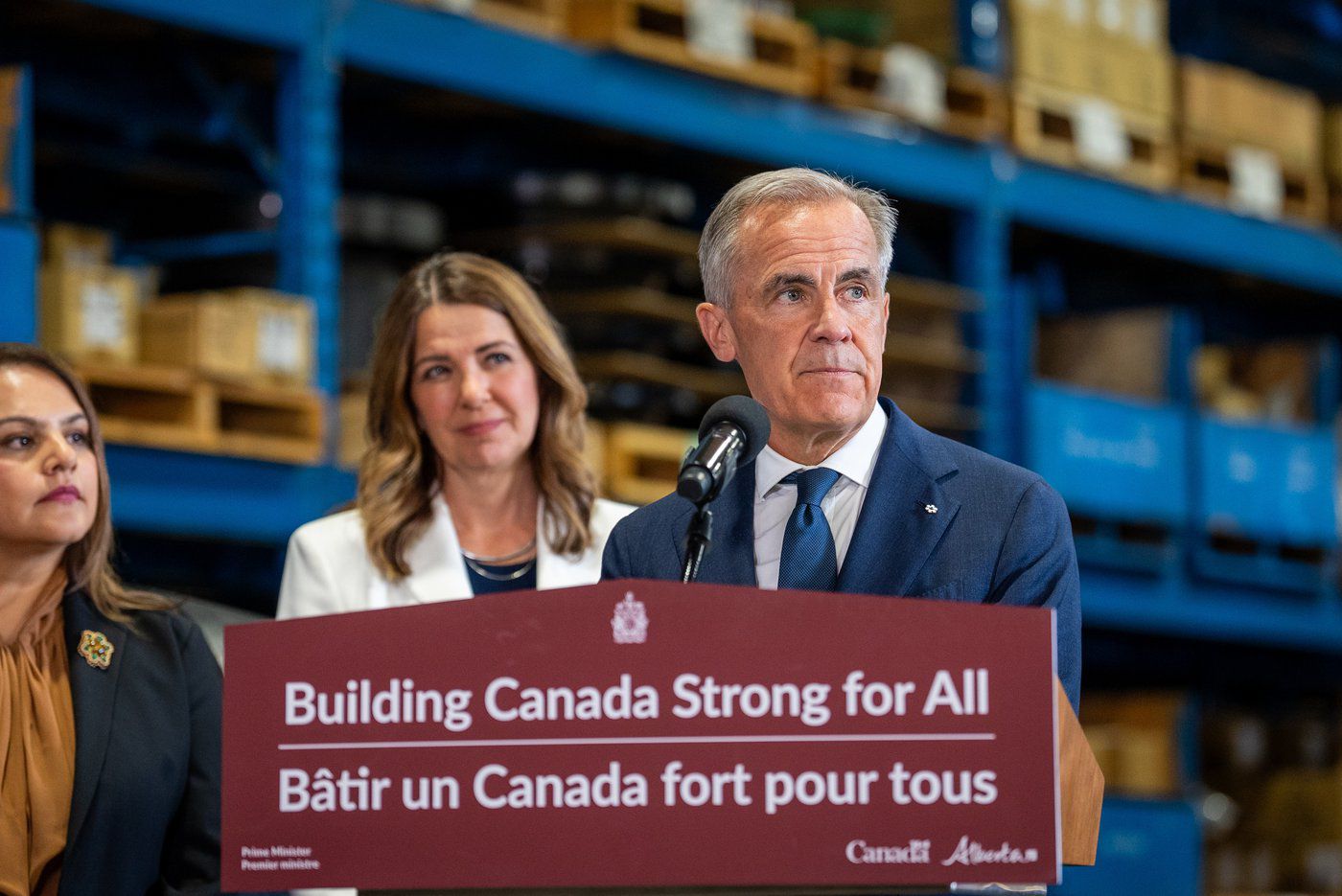
Prime Minister Mark Carney and Alberta Premier Danielle Smith announce a proposed pipeline from Alberta to the BC coast in Calgary on July 02, 2026.
One month before the federal government is expected to decide if Alberta’s proposed West Coast oil pipeline is a project of national interest, a new international report is challenging whether the pipeline is needed at all.
Existing pipelines and lower-cost expansions could handle Western Canadian oil production today and in future without a major new corridor, said Mark Kalegha, an energy finance analyst and co-author of the report released Tuesday by the Institute for Energy Economics and Financial Analysis, a global think tank that studies energy markets, trends and policies.
“If there’s a deficit, then we could say there’s a need for a pipeline to move these products out,” Kalegha told Canada’s National Observer. “But what we saw is there’s more than enough pipeline capacity.”
Under the current proposal, the governments could ultimately own about 90 per cent of the project, leaving taxpayers exposed if construction costs rise or the pipeline is delayed, the report says.
The report tested whether a new pipeline is needed by comparing projected Western Canadian oil production with available pipeline capacity under four scenarios through 2050. One scenario assumes current policies continue and production rises before levelling off. Another assumes stronger economic growth and higher oil prices. The other two assume weaker oil demand, including one in which Canada reaches net-zero emissions and uses more low-carbon technology.
Existing pipelines and planned upgrades would be enough in three of the regulator’s four scenarios. More capacity would be needed only if oil production reaches the regulator’s highest forecast, Kalegha said — a scenario that assumes Canada, and the rest of the world, largely abandons climate efforts.
Increased capacity possible on existing pipelines
The report names many projects that could add capacity without building a new pipeline. Enbridge’s Mainline Optimization Phase 1 would add 150,000 barrels per day, while an expansion of the Express-Platte system would add 30,000. Trans Mountain’s approved project would add another 90,000 by using chemicals at existing pump stations to help oil move more easily through the pipeline, “rather than building a new pipeline and having to dig up the ground,” Kalegha explained.
“It’s a very cost-effective way to increase capacity.”
Other pipeline expansion projects are still being planned. Enbridge’s Mainline Optimization Phase 2 could add 250,000 barrels per day, while Trans Mountain’s Mainline Optimization project could add 210,000. The report says combining all the near-term projects could add about 550,000 barrels per day.
Kalegha pointed to South Bow’s Prairie Connector as a longer-term option that would follow existing pipeline corridors and reuse about 150 kilometres of pipe from the cancelled Keystone XL project, with its first phase capable of adding between 450,000 and 550,000 barrels per day.
“Brownfield projects — which are expansions of already built pipelines — offer the best bang for investment bucks,” Kalegha said. They are cheaper to build, less likely to face costly surprises and may have less impact on the environment than a new route, he said. Lower construction costs would also mean lower transportation fees and more profit for producers.
The proposed West Coast pipeline, expected to cost between C$35.2 billion and C$43.7 billion, would carry up to one million barrels of crude oil per day from Bruderheim, Alta., to a deepwater port near Delta, BC. The Alberta and federal governments say it would diversify exports, send more Canadian oil to Asian markets and reduce Canada’s reliance on the United States.
Most expansion projects highlighted in the report would send Canadian oil to US refineries, but two Trans Mountain projects could add about 300,000 barrels per day to the westbound system, serving the BC coast and Asian markets, Kalegha said.
But most producers aren’t concerned about where the oil goes, Kalegha said. “If you’re a producer, you’re looking at how to generate the most profit per barrel shipped,” he said. “I’m not necessarily convinced that the producers themselves prefer a certain destination to another one.”
The report estimates the proposed pipeline route to reach Asian markets would have the highest transportation fees among Alberta’s major export pipelines, and could be too costly for producers.
Using a model based on the Trans Mountain Expansion Project, the authors estimate that companies using the new pipeline would initially pay between $18.70 and $23.72 per barrel in transportation fees.
Will Scargill, an independent consultant and the report’s co-author, said the fees could cancel out any higher price for Canadian oil shipped to Asia.
“The high cost and high tolls mean that exports through the pipeline would likely earn less for producers than other routes,” Scargill said.
The report says the pipeline’s transportation fees would be so high, producers using it could have US$5 to US$8 (CAD $7 to $11) less left from each barrel than they would without the project. Across the industry, that could amount to between $2.2 billion and $3.2 billion a year over the 20-year contract period.
“Even if Asian buyers were willing to pay more than US markets, that benefit is likely to be more than offset by the much higher cost of using the proposed pipeline to reach the Pacific coast,” Scargill said.


No replies yet
Loading new replies...
New Member
Join the full discussion at the TheRegional / Chat →